Socialive resource center
Key takeaways:
- Always prepare before opening up an editor
- Pick the right tools for the job
- Work in a templated, streamlined structure
If you fail to plan, you plan to fail. Benjamin Franklin's words apply to many scenarios, especially if you lack experience and need to edit video content.
Professional video editors have learned many things that become second nature. Yet, these tricks of the trade are foreign to those unfamiliar with video editing.
How should you prepare your content? When should you use — or not use — B-roll and transitions? How do you set up a solid template? What on earth are hotkeys?
For those content creators who have yet to master the art of video editing, we thought it would be helpful to compile a quick guide with some of the basics. By the way, if you come across any terms that you’re unfamiliar with, feel free to reference our glossary of common video terms.
Plan, then edit
Before you open up any software or platform to edit video, you should start with an outline of the final product.
Think of how a carpenter measures twice and cuts once. Sure, you can jump in and start making changes, but it’s helpful to have a picture of the finished video so you don’t try to whittle your project to oblivion.
Here are some considerations that will inform the decisions for your content:
- Which channel is this for? Social media? Email? Internal reference only?
- Is this a part of a campaign? Video series? A standalone piece?
- Who is the target audience of the video?
- Is this meant to be snackable content, or is this a deeper dive?
- What tone do you want to come across?
You can save precious hours and headaches by keeping the end goal in sight at the beginning. Rather than constantly tweaking and iterating, think deeply through what you want — then execute.
Communicate with your intended recipient
No, we don’t mean “put out a poll on social media and ask the people what they want.” However, that type of crowdsourcing can help generate some great content ideas!
Talk to someone on your team who represents your audience. You’ll want to partner with someone who has a strong viewpoint.
If you want to catch the eye of C-suite buyers with a thought leadership clip, your team lead or department head can provide some guidance on the type of content that might resonate. They may tell you, for instance, that tons of jump cuts and pop music might not work with that audience. Or maybe that’s precisely the vibe you want.
Either way, you’ll want to at least have a quick chat with someone who can help guide your efforts. And it can’t hurt to get the insights of whoever will review your video, as well.
Organize your footage before you edit
It sounds simple, but the admin work goes a long way. It doesn’t matter if you recorded a bunch of footage on a camera at an event or if you have a repository where contributors sent clips.
Take the time to label and clean up your recordings early in the project. You’ll thank yourself later.
Label your clips in a way that will be easy for you to navigate. One suggestion is by project, talent, the primary talking point, and then date.
Ex/ Company case study - Jane Smith - video roi - 052324
If you’re working in a platform where you can organize your content into a hierarchy of folders or channels, even better!
The same process goes for B-roll, music beds, graphics, logos, or anything else you’ll build into your video. Of course, you’ll want to make sure you’re only picking the right content that fits the project.
For instance, it would be a bit weird if a romantic comedy with Meryl Streep had an intense Hans Zimmer score and Christopher Nolan explosions. If you can picture the final video at the start of the project, the actual editing process will go that much smoother.
Pick the right tool for the job
Finally, you need to actually edit the video.
In the same way you thought through where the video should go, you should think through how you’ll make it. If you want to make a video with tons of effects and wild transitions, Adobe Premiere is the standard. But if you just want to make a few cuts and add some quick branding, you probably don’t need Premiere.
Check out our comparison of some of the top tools to edit video on the market. You wouldn’t use a jackhammer to hammer a nail, so likewise, picking the right tool can streamline your edits.
Work within a templated structure
Once you have the right tools, build your project. Structure your setup in a way that makes the most sense and can help keep everything uniform.
Here’s a sample outline we use for many of our videos for social media:
- Cold open with a clip from the speaker (5-10 seconds)
- Include speaker’s lower third
- Intro animation (5 seconds)
- Scene one with topic one
- Clean feed from speaker’s ISO
- Scene two with deeper explanation
- Includes B-roll or a two-shot for panel discussions
- Scene three with a solid take-home point
- Supporting graphics
- Primary CTA and outro card (5 seconds)
Once you have a templated structure for your content, it becomes much easier to create videos at scale. The only true editing you’ll need to do is to swap out a few logos or graphics, tighten up the talk track, and then get your content ready for review.
Our marketing team uses a similar structure for case study video content. Every promo video, testimonial clip, and the final video for the case study have the same branding. We use the customer’s logo, a Socialive-branded frame, custom intro animation, and the same CTA at the end of each video.
Most video editing software and platforms allow you to save your work. When you close a project, you can open it again later and pick up where you left off.
It’s also helpful to work within a structure that supports templates at the team level. If you’re able to apply standard graphics, logos, and music at that global level, it then becomes easier to quickly edit more and more content.
Learn the hotkeys
Hotkeys are keyboard shortcuts that perform specific actions in a video editing platform.
Most are familiar with “spacebar” playing your video. “Control + Z” (or “command” on Mac) undoing an action.
But everything from making a cut to inserting a transition to creating a new scene will be programmed in. Advanced software, like Premiere, will allow you to program your own shortcuts — hotkeys — that let you perform specific actions with the click of a button.
It may not sound like much, but saving time from a few drags of the mouse or clicks adds up. Anyone who has had to move hundreds of clips a few frames to insert a new clip can tell you how frustrating the manual process is. Learn the hotkeys, it’s worth it.
Socialive is no exception. With our AI-powered video editor, many of the editing actions are made easier, if not automated. But for those hands-on tasks you need to take, the hotkeys will save you tons of time.
Edit video faster and easier by planning
By organizing your recordings and content, strategically planning your story, and picking the right tools to set up a templated structure, just about anyone can edit video like a pro.
Of course, we wouldn’t recommend someone who is just starting out to take this and think they can run a production company. But these tips are certainly helpful for someone learning the ropes.
If you work within a company that offers video services or more seasoned editing professionals, ask plenty of questions and have conversations with them about how you can fully set up a self-sufficient video ecosystem. This is key to making video creation scalable.
The final step of your editing journey is to pick out the right tool, learn the ins and outs, and try it for yourself. You can start with Socialive’s CreatorSuite, which is built with many of the helpful features we covered — plus many we didn’t, such as text-based video editing.
Key takeaways:
- AI saves time and money compared to traditional video editing
- Majority of cost comes from logistics and expenses tied to specialists
- Socialive’s AI-powered editor is fast, easy, and scalable
Sometimes it’s OK to believe the hype — especially in the realm of AI-powered video editing.
The type of AI usage we’re talking about is known as a “centaur.” Half man, half machine. Think “Inspector Gadget.”
Thanks to AI, expert and inexperienced video editors alike are finding it faster and easier to edit video content. We’ve seen individuals without a background in editing easily take on what used to be an hours-long editing project. In just a few clicks, they can get the job done.
The future is here in video creation, and the use of an AI-powered editor is leading the charge for many. It’s driving down project expenses and speeding up timelines. Here’s a view into how big a difference an AI-powered editor makes.
Traditional video editing is broken
There’s always been a fairly standard approach to video creation across large corporations. A videographer shoots the footage, and then a specialist makes all of the adjustments and sends it off for review. The specialist makes more adjustments and edits, and finally, the video is approved.
Not only does each handoff require time, but an expert in video editing is often required each step of the way. Regardless of the project’s complexity.
Need to add a logo to a CEO’s recorded town hall message? Send it to your expert to edit. Want to trim an hour-long webinar into a social clip? Send it to the expert. Want to repurpose an interview with a thought leader into a quick soundbite? You know the rest.
An expert shouldn’t be required for short-form video clips that only need a couple of minute adjustments. It makes much more sense to delegate or automate the task. Socialive’s AI-powered editor helps people do both.
Understand that when we say “an AI-powered editor,” we’re not just talking about the technology itself. We’re also referring to the people in place, formally trained or otherwise, who use AI to make edits.
AI powers massive cost savings in editing
In video creation, time is money. It doesn’t take much of a leap to see that each hour of production saved makes a huge difference in the cost of the overall project. Likewise, saving an experienced editor’s time — or their involvement in a project — has an impact.
We’ve examined the underlying numbers and found that an AI-powered editor can save an organization as much as 14 hours per video project and up to $1500 in costs.
Socialive’s AI-powered editor saves time
Each part of the Editor is built to speed up and simplify the process of getting your video out the door. From templates that eliminate manual actions to microscopic cuts, everything is designed to make the editing process as efficient as possible.
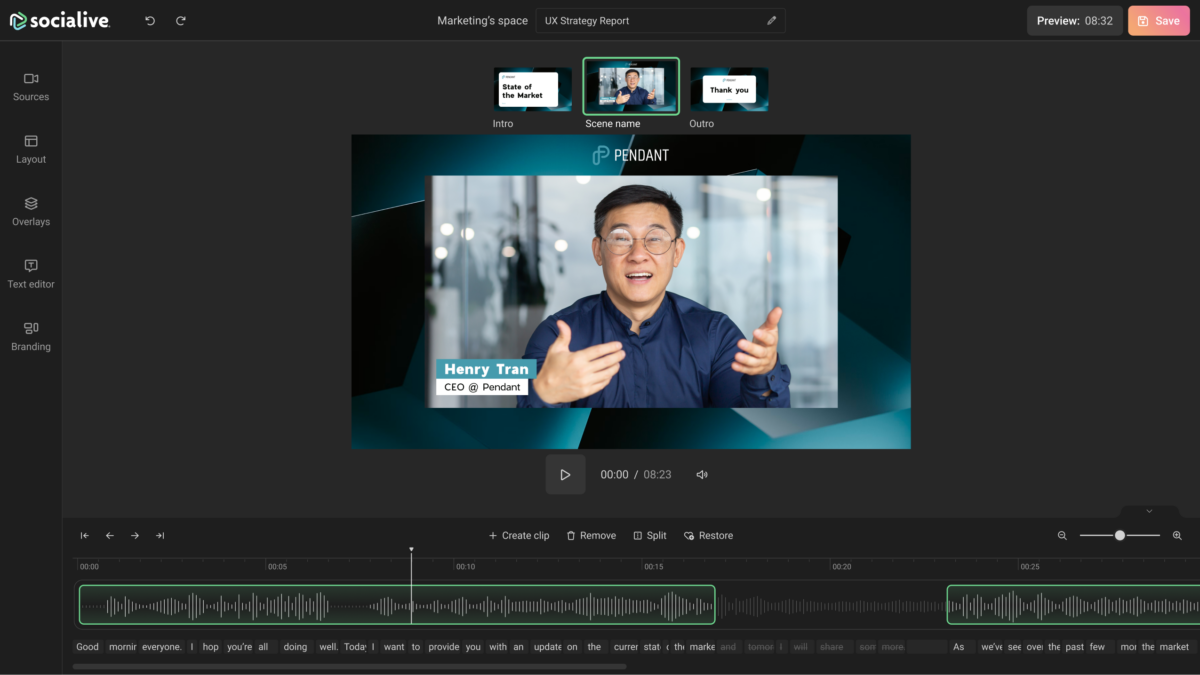
Setting up presets and templates
Repeatable, standardized formats allow organizations to create at scale. Spaces enable admins to automatically apply design elements like logos, lower thirds, intro cards, and other graphics to new recordings.
This not only eliminates the need to ask an editing specialist to “quickly add a logo” to an existing video — it sets the stage for batch editing. There’s no need to open a file, render the footage, add and place a single overlay, and then export. Socialive’s AI-powered editor does it all in your browser without any need to click into the video.
The old way may have taken just a handful of minutes from the time someone opened the file to when they exported the rendered video. With Socialive, the preset is applied to each video with a single click.
Automated captions and transcripts
Captioning is one of the more tedious parts of video creation. Again, Socialive handles it for you.
For most individuals, captioning each minute of video takes about five minutes. The instant you open the Editor, the video file has captions available to download and a transcript linked to the timeline.
Text-based editing

With the transcript tied to the video timeline, people can use the transcript to identify and fine-tune each moment.
This is a huge step for those without much video editing experience. Learning the relationship between wavelengths, audio, and visual elements takes some practice. Anyone can interpret words on a screen.
The AI-powered editor makes it easy to then make adjustments in a user-friendly way. The text-based editor lets you edit the text as you would in a document, and those changes are applied to the video.
Studies have shown that this text-based approach to editing can cut more than 30 minutes of editing time per minute of video. It’s why the established players like Adobe Premiere, down to newer tools like Descript, have emphasized text-based video editing. It makes for a much more approachable and delightful video editing experience.
Precision editing
These approachable tools make it easy to apply small branding changes in a template to make broad changes. It’s great for inexperienced creators.
But an AI-powered editor also makes it easier for deeper, more precise edits.
The traditional wavelength-based timeline experience lets users adjust each clip down to the millisecond. The drag-and-drop experience makes it simple to clip, add graphics, and build in a storyboard.
Rather than needing to set ins and outs in one window and drag footage to the timeline, you simply highlight a region on the timeline and adjust the boundaries.
Automated layout recognition
Another benefit of an AI-powered editor is its ability to handle multiple pieces of media. For recordings paired with screen share, Socialive automatically recognizes each feed and arranges them into a picture-in-picture layout.
The Editor makes it that much easier to quickly record an instructional video or walkthrough and produce a nice V1 in an instant.
Socialive’s AI-powered editor wins out
Socialive is an enterprise video platform built for thought leadership. We’ve covered the strengths and weaknesses of many competitors and best use cases in previous pieces. Overall, there are a few ways Socialive maximizes the time savings compared to other AI-powered editors.
Adobe Premiere: too specialized
The behemoth in video editing, Adobe Premiere, is the standard. The vast majority of professional video editors are trained in the platform and use it regularly.
The problem with Premiere is that it requires a certification before you’re up and running.
Plus, the platform is often overkill for simple projects. Consider a use case where someone needs to quickly apply a watermark, intro, and outro to a video.
It takes a couple of minutes to download the video file. A couple more to render it in Premiere. A few more minutes to export. And then finally, after another few minutes to upload the finished video, it’s ready for review. Now imagine there are dozens or hundreds of videos that need that quick adjustment.
With Socialive, there’s no need to download or render any of those recordings. The presets will apply all of those elements, making it a much more efficient process.
Canva: not powerful enough
Canva, unlike Premiere, is designed almost exclusively for hobbyists and people without formal training. No training is needed!
Unfortunately, Canva doesn’t offer the same type of tools needed to make those more precise edits. It’s great for a quick adjustment, but much more difficult to use for nuanced changes.
It’s also lacking when it comes to the enterprise tools that could truly make it a scalable platform. Canva lacks the transfer and publishing integrations and security measures needed to sit as a core piece within a company’s video infrastructure.
Socialive: the perfect blend for the enterprise
Socialive combines the power of Premiere with the ease of use of Canva. It's an all in one, end-to-end platform built for the enterprise. The AI-powered editor, like every other part of the Socialive platform, is built to securely connect with every other part of a corporation’s ecosystem. The platform’s integrations make it fast, easy, and safe to create video content at scale.
Making video creation cost-effective and scalable
Socialive puts the power of an advanced editing tool into a user-friendly format anyone can use. By saving time, reducing complexities, and sparing the need for a professional to work on each and every project, video editing is becoming that much more cost-effective. While it can vary per project, early data show that AI can save about 14 hours per video project and up to $1500 in costs.
The AI-powered video editor, paired with Socialive’s recording and publishing features, means that external software is not needed at any stage of the video creation process. This new, streamlined workflow, is saving time and money in video creation end-to-end.
Key takeaways:
- Outsourced video shoots can cost up to $25K
- Socialive makes it easy to record high-quality video from anywhere
- Remote recordings are immediately available to edit or publish
Video teams know all too well how difficult it is to execute projects that include widely distributed talent. We’ve covered the costly logistics of either sending a camera crew or bringing people to a centralized location — which can cost businesses as much as $25,000 per video.
Remote recording sessions cut out all the travel costs and make it easier to include everyone in videos. But how else are remote recording sessions beneficial to enterprise video teams?
Using an end-to-end video creation platform — purpose-built to remotely record video, edit it, and then publish — allows video teams to create professional-grade videos in a flexible environment.
So much of what happens behind the scenes also adds to the cost of each video. Just ask VMware, their team saved around $1000 per video by streamlining the back-end process.
Here’s how video teams can create crisp and clear recordings that won’t run up the budget while ensuring talent always crafts the perfect take.
Flexible, professional video recordings in Socialive
Quality always comes first. It’s non-negotiable, and cost-saving solutions can’t sacrifice high quality.
When we say “professional quality,” we mean both pristine picture quality and branded assets within the video. It’s the combination of these two factors that creates a professional look and feel.
This is where the end-to-end functionality of Socialive — one platform to record, add that extra bit of polish, and then publish — guarantees quality at every step.
With recordings in up to 4K, cloud-to-cloud file transfers that maintain full resolution, and the ability to add previously created graphics and overlays in a drag-and-drop editor, teams can add professional quality in an instant.
Cost-cutting video recording workflows
The most consistent cost-reduction video teams see is in the amount of time the platform saves.
Executives and leaders over large creative teams will be happy to know that you don’t need to overhaul the operation to reduce the cost of each video created. It comes down to tweaks to what teams are already doing.
Much of what video teams do to create content will remain the same — it’s the how and the where that shifts.
Taking VMware as an example, the creative team for the aforementioned global technology company simply changed some of the back-end logistics without a rip-and-replace approach. Socialive built on top of their existing infrastructure and connected a previously disjointed process.
Maintain quality with producer-led sessions
The conundrum many video teams face is the thought of losing control by giving talent complete autonomy.
This may sound like a quality issue, but don’t forget that most video teams are already at capacity — there’s no time for reshoots. Each additional hour the final video is pushed out costs your team in productivity and makes the entire project more expensive.
Think of who you want to feature — busy executives, salespeople in the field, internal thought leaders, or other individual contributors. They might all be great in front of the camera, but they lack the experienced eye of a video expert.
Socialive makes it easy to set up a guided recording session and then invite talent to join. Producers manage from behind the scenes, give tips on lighting and framing, and can help guide talent to deliver the perfect take.
The ultimate goal is to strike a balance where your talent is given enough guidance on the front end so that they can get after it on their own in a guided format.
An HD camera and screen recorder like Socialive’s CreatorSuite works well to let talent record on their own schedule, but still provide guardrails.
Crowdsourcing content in this way is an efficient process, but it doesn’t come at the cost of quality.
Record anywhere with any device
The biggest benefit of remote video recording is that it’s … remote. Any place, any time, with any device, you’ll get great picture quality.
The ideal state is that everyone in your organization would have their own professional camera and audio equipment and record from a soundproof, well-lit room.
But expensive equipment isn’t always necessary. Most mobile devices record in 4K, even up to 8K, and it’s fairly straightforward to hook up a high-quality external microphone.
No matter what device you want to use — from a webcam to a DSLR or even professional studio cameras — Socialive uses these cameras as sources in your recording session. Same goes for self-guided content creation.
This flexibility means that video teams can get similar studio-quality results without the logistics of traveling to a studio.
Even if you’ve already invested in your own in-house studio, have your own equipment, and talent lives nearby, Socialive seamlessly connects every disjointed part of the video creation process.
Everything saved in one place
Who’s ever had to ask an executive to hunt down a video file from a self-guided recording? How long does it take for files to download and upload files from one place to another — or worse, manually transfer media from hard drives or memory cards?
With Socialive, there’s no need to wait for files to transfer. The instant they are recorded, everything is transferred to a centralized recording library. No need to ship equipment or any hardware back and forth.
Plus, the platform always keeps the recording at its original resolution, up to 4K. It’s immediately ready to edit or publish, further accelerating the creation process.
For VMware, this created the bulk of their $1000 savings per video. They eliminated the need for any physical hardware for storage and transfer, plus each video project is now completed quicker. Just the ability to instantly transfer video from recording to editing to review and the final destination — all through Socialive — produced a massive ROI for VMware.
Remote recording vs. studio recording: a cost breakdown
In addition to the time saved in the creation process, there are fixed costs associated with studio-bound recording sessions.
We go further in-depth on this cost comparison in another post on the ROI of changing from a studio-first model, but here's a quick breakdown.
Travel costs
Studio recording: Approximately $470 per day per person for anyone traveling from out of town.
Remote recording: Nothing. There is no need for travel.
Freelance video personnel
Studio recording: The range is anywhere from $25 per hour to $400 per hour per person. So this could cost between $200 and $3000 per person per day for an 8-hour shoot.
Remote recording: Again, this figure could be cut to $0. Unless you outsource script writing or editing, you likely won’t need extra hands for remote recording sessions.
Studio space and equipment rentals
Studio recording: The conservative estimate is $50 per hour to rent studio space. For an 8-hour shoot, the daily cost is $400. If you need to rent equipment, that’s at least an additional $25 per hour, another daily cost of $200.
Remote recording: Well, unless you have the burning desire to use a location you need to rent, the studio cost is guaranteed $0. The equipment cost is up to you, but as we’ve stated, Socialive enables you to get crisp picture quality without budgeting for the most expensive hardware on the market. But if you have top-end equipment, you can still use it to record.
Your team’s time
Studio recording: Taking Akamai as an example, the studio-bound approach doubled the time it took to create each video.
Remote recording: With Socialive, Akamai cut the time it takes to create a video in half. They’ve saved 12–24 hours in editing time and file transfers, and create about 30% more content each month without spending more money.
Final tally
Heading to a studio adds around $1000 to the cost of each video and massively reduces the productivity of each video team. Creating professional-quality recordings with an end-to-end video creation platform is the clear winner.
Of course, these are just approximations, but they should give you an idea of what’s possible. The remote video recording workflow might not be perfect for each and every video, but for projects that don’t warrant a $25,000 spend for the final video, remote recording is the perfect solution.
This is where Socialive powers the growing middle of video creation. Teams are able to create more video content with the same resources in place without sacrificing quality.
Cost-effective video creation with Socialive
Remote recording isn’t just for “in a pinch” scenarios, it’s the first step to an efficient, cost-effective way to create videos. A platform like Socialive guarantees high quality every step of the way.
With Socialive’s end-to-end video creation platform, teams can record what they want, how they want. Let your team use any device, and our platform instantly moves the video to the next phase. When using an automated video editor, the ROI then truly takes off.
This all saves enterprise teams like VMware’s events team thousands of dollars per project and enabled them to create more video content without spending more money.See how much your team could save in video creation.
Key takeaways:
- Business travel for video creation emits upwards of 0.40 pounds of CO2 per traveler
- Companies can meet ESG criteria more easily with remote video creation
- Businesses using Socialive create more sustainable and inclusive content
Environmental, social, and corporate governance (ESG) programs demand that businesses comply with the latest sustainability practices. While ESG covers so much more, reducing emissions and the carbon footprint are baked into how many companies operate.
Video is one of those categories that may go unnoticed when it comes to environmental impact.
The traditional approach to video required travel, accommodations, on-site logistics, and tons of expensive equipment. But with video platforms built to create content from anywhere — without sacrificing content quality — it’s becoming easier for businesses to scale up their video output without running into ESG risks.
Here’s how companies are able to reduce the environmental impact of video by using Socialive.
Traditional video creation isn’t built for ESG
The old way of doing things was wasteful.
We’ve harped on how wasteful on-location video shoots can be, costing more than $1000 per video in travel alone. But money isn’t the only cost of an on-site video shoot.
Companies contribute to pollution when they send a video team into the field or bring individuals into a studio. Beyond that, there are elements like feeding your production crew and equipment usage that also generate waste.
The need to get people to and keep them at a physical location for video productions costs the environment.
Carbon emissions from travel
It’s well understood that most corporations’ video shoots don’t replicate the model of a big-budget feature film. Still, the Sustainable Production Alliance’s white paper on the carbon footprint of film and TV production shows that content creation can contribute to carbon emissions.
The SPA’s study showed nearly 25% of emissions come from travel, which highlights the impact of on-location video shoots.
Decision-makers may be aware that travel related to video creation can cost around $470 per day. But they should also consider each flight produces around 0.40 pounds of C02 emissions per mile per passenger.
Simply put, when balancing the budget, the production’s carbon footprint should also be taken into account.
On-site logistics
Sticking with the comparison of film sets, they can generate upwards of 72 tons of food waste. A company’s video shoot probably isn’t at that type of scale, but if you have a crew, you need to feed them. Food waste also harms the environment.
Beyond catering and water, accommodations, local travel, and energy usage all go into consideration. Limiting the number of people on site can help manage the amount of waste coming from a video shoot.
Equipment usage
The SPA’s white paper also showed that fuel made up nearly half of the emissions from productions. This was mostly due to generators to provide power for lighting, trailers, and other equipment.
Again, most companies aren’t putting those types of resources into their content creation. But even something as simple as a studio reservation, the use of high-grade lighting, or dragging along 100 pounds of camera equipment all contribute to emissions.
Especially if the equipment needs to be moved back and forth between locations, the environmental impact of shipping must also be considered.
This isn’t to say that a large-scale video production is bad for the environment or that we shouldn’t travel to capture content. But, it points out we should be intentional about when we go into the field.
Remote video creation supports sustainability goals
This is where a video creation platform like Socialive can help companies drive down the emissions of their content creation.
There’s no need to send a camera crew to a location or bring talent to a studio. Instead, the platform provides a number of ways to self-record from anywhere or to create a remote recording session with a producer on the other end.
Remote video shoots are a sustainable way to livestream or to record, edit, and then publish content. Especially when the content doesn’t warrant a full production crew, a platform that lets you create from anywhere makes it more “worth it” to tell that story.
No travel means fewer emissions, lower costs, and an increased ability to create more content. Remote content creation is the more sustainable approach compared to traditional video production.
How the Royal Society of Chemistry cut emissions with Socialive
The Royal Society of Chemistry hosts in-person conferences, roundtables with subject-matter experts, and sends their leadership to events across the world to promote advancements in chemistry. However, the association had to pick and choose between events they could attend.
As an organization focused on ESG and net zero, the RSC prioritized its carbon footprint and skipped many events. For the global media team, this meant that they were unable to cover the events they would like to. Plus, their panel discussions primarily featured the same few people located close to their London offices.
With Socialive, the RSC’s media team doesn’t have to worry about travel for each of these discussions. Every in-person event is livestreamed, so there’s no need for long travel to attend their events.
The RSC’s media team also uses Socialive to “be the expert not in the room” when there are events in other parts of the world that matter to the RSC. At an event like COP28, the RSC can send a handful of members — who were likely going anyway — to be on-site videographers and talent. The platform lets the media team produce each recording session and conversation from behind the scenes.
By reducing the amount of food, water, and travel for events, the RSC continues to lower its carbon footprint.
An added bonus for the RSC is that more of its members across the globe can participate in events virtually as a presenter or watch online. In addition to trimming their environmental impact, the RSC includes more people and perspectives in their content.
The social and governance impacts of video
We’ve mostly harped on the “E” of “ESG,” but the video also has an effect on social and governance practices. Video is the ideal medium for companies to showcase their people and help increase transparency.
Promoting diversity with video content
No one would suggest that simply showcasing a few people of color or women on screen is “doing DEI.” But for companies who do prioritize diversity, equity, and inclusion and have a strong social impact, video is the perfect way to show it.
Video reinforces the hard work that’s already been done. It’s not enough to do the work and keep it hidden behind the scenes.
Increasing transparency with town halls
Similar to promoting diversity, video can’t guarantee rock-solid corporate governance. But when corporate social responsibility is taken seriously by an organization, a town hall can help keep the leadership team accountable and provide transparency to employees and stakeholders.
Giving a direct line to leadership and making it so everyone in an organization has access to the powerful people in the room goes a long way to reinforcing the corporate culture.
Supporting ESG goals while creating video content
There are major steps that can be taken to reduce the emissions around video creation. By eliminating unnecessary travel, increasing the number of people who can feature in content, and providing a way to showcase the ins and outs of their operation, businesses can create video in a way that is much more in line with ESG considerations.
It won’t make you a B Corp company overnight, but sustainable video creation is well within reach.
One of the other ways many Socialive customers support their ESG goals is to create truly inclusive content that features the types of voices and stories that were deprioritized in the past. Check out how companies are using Socialive to create DEI video content to learn more.
Eighty-eight percent of U.S. consumers use financial technology for banking, payments, and investing — up from 58% in 2020. As a result of the rapid disruption driven by fintechs, customers now have higher expectations for seamless digital experiences across all the financial services they use.
To meet these expectations and adapt to an increasingly remote and mobile-first world, many traditional finserv organizations are progressively turning to video to provide a more modern yet personalized and engaging experience. For finservs, video will be critical in driving recruitment, streamlining and enhancing customer interactions, and increasing brand awareness to reach new audiences.
TL;DR — video marketing is critical for the finance industry.
Video transformation in the finance industry
We dove deeper into these trends in Episode 4 of our Creator Economy webinar series, The “Personalization Promise” in 2022: Video Tech strategies for Financial Services. We also hit on these trends across several assets for the financial services industry.
Many of the trends are outlined below, but if there's one takeaway for the finance industry — video is the primary way to connect with clients, prospects, and the masses.
The opportunity for financial services innovation
In addition to higher consumer demand for more engaging digital experiences, finservs are also facing a talent shortage. Financial institutions are racing to attract younger talent due to wave of early retirements, as well as a widening digital skills gap — both exacerbated by the COVID-19 pandemic.
But amid the Great Resignation, attracting top talent has become daunting, especially for organizations that lack an ethos of innovation. Add the challenge of increasingly dispersed work environments to the mix, and you’re looking at a major turning point for the financial services industry. The good news is financial institutions now have an incredible opportunity to transform and grow.
But how?
Self-serve video tech has emerged as a key solution to meet these challenges.
Cloud-based video production technology allows finservs to meet customers where they are — online — and meet the demand for engaging digital experiences while building more authentic, transparent relationships. From a talent acquisition standpoint, video enables recruiters to cut through the noise and reach an infinite pool of candidates from anywhere, at any time.
The personalization promise
Finservs can solve two very different problems — demand for digital consumer experiences and talent acquisition — with a comprehensive video strategy. In the end, it all comes down to personalization. Customers want to feel valued and understood, and job candidates want to feel like more than just another cog in the machine.
Forward-thinking finservs are already turning to enterprise video solutions to:
- Provide a modern, personalized, and engaging experience
- Engage prospects and customers across channels, including social media
- Create more touchpoints with customers
- Conduct roundtables, panels, and webinars
- Connect with customers virtually yet authentically
- Recruit top talent and keep current employees engaged
- Overcome consistency, compliance, and security challenges
Your livestream is over. Now what?
We tend to think of live video as a single-serve type of content, one whose relevance and utility lasts only for the duration of its runtime. Better, the argument goes, to invest in evergreen content – the web videos and blog posts that deliver results day-in and day-out.
When used strategically, however, live video can also be a kind of evergreen content.
Repackaging and repurposing livestreams is an efficient way to multiply your content output – both for organic and for ad units.
Here’s how to turn your live video into content that keeps on giving:

Livestreams Are Raw Material for More Organic Content
Since its most typical use is to present interviews, demonstrations, and events in real time, live video – as a medium – tends towards greater length.
By definition, then, a generic livestream will result in a larger quantity of content than, say, a short edited video or a 400-word blog post.
When devising your content strategy, it is important to think of your livestreams as a repository of raw content – material that you can chop up, mix up, package, and repackage to generate lots more content.
As an example, one Socialive customer used the footage from three streams to generate content for 47 additional long- and short-form videos.
How do you repackage a livestream to produce more organic video?
> Segmentation: Take an hour-long livestream and edit it into shorter segments – 10 minutes, 5 minutes, or even shorter. Simply segmenting your video in this way can yield upwards of five or ten new pieces of content, all mined from a single livestream.
> Theme-based clips: In the course of an hourlong panel discussion, say, panelists may visit and return to a few core themes. Editing shorter video clips that explore a single theme is a way to bring focus and cohesion around key ideas.
> Highlights: Not every second in an hourlong stream will be thrilling. But, usually, a single livestream will feature a handful of noteworthy moments. Spotlight those moments in stand-alone clips or produce a highlight reel.
Through smart content strategy, a single livestream can generate dozens of additional pieces of video content – which can be posted or published as regular, non-live video.
But more, this approach provides the added benefit of parcelling out content in bite-size lengths, so people are more apt to consume it. (It’s far easier to commit to watching a 2-minute video than a 1-hour video.)
Ultimately, increased video output, paired with enhanced watchability and the curated packaging of content around exciting moments or thought-provoking ideas, has the effect of spurring awareness and interest around your original livestream as well as your brand.
Repurpose Live Video for Ads
As we’ve discussed before, live video is uniquely compelling – producing 10x as many interactions as regular video, the next most popular content type.
Part of the appeal of live video is its real-time quality: Audiences can tune into an event or a broadcast as it occurs. But livestreams – on digital channels – are also engaging for their authentic aesthetic.
By repurposing livestreams for ad units on digital channels like Facebook, YouTube, LinkedIn, and so on, brands can reap the benefit of the potent style of live video content, without having to separately produce it.
According to Socialive data, ads that use repurposed livestream video frequently outperform traditional video ads.
In one instance, a Socialive customer reduced cost per acquisition (CPA) by 46% by repurposing live video for digital ads. Another customer drove down cost per view (CPV) to $.01.
How do you repurpose a livestream for video ads?
> Experiment with length: Create different ad units based on 15-second, 30-second, 1-minute, and 3-minute clips or trailer-style highlights using livestream footage. Pick moments that are impressive, persuasive, or otherwise engaging and craft the edit to maximize the effect those moments produce in a viewer.
> Experiment with content: Within the parameters of runtime, try to communicate a different story, message, or feeling with the video content you repurpose from your livestream. Try, for instance, a simple, unedited clip to spotlight some dramatic moment; or consider editing a series of moments together to conjure energy and excitement.
> Strategically test your video ads: Consumers can encounter your ads at different points along the buyer’s journey. Test which of your ads – what runtime, what content – most resonates with your audience at each stage, from top-funnel awareness building to retargeting high-intent prospects.
The lifespan of livestreams – when used strategically – can be long.
By repackaging and repurposing a livestream, a single pillar video can produce dozens more stand-alone pieces of content. And as the engagement power of a live video – expressed in live’s distinct aesthetic – persists even after a video is no longer live, its footage can be used to create compelling ads.
For organizations seeking efficient, evergreen content, live video is the answer.
Cloud video production — recording, producing, and distributing video in the cloud — is quickly becoming the dominant form of video production. A 2022 global survey of video editors, producers, managers, and prosumers found that nine out of ten video users have adopted end-to-end video creation and remote editing in their workflows.
This shift has unlocked dozens of new use cases for businesses. One way organizations are maximizing cloud video production is by capturing content in the field. The stunning picture quality on today’s phones and tablets means employees have the ability to capture studio-quality video in the field with the devices they already have.
Socialive’s cloud video production tools automatically transfer this content to your organization’s secure, centralized library in the cloud for immediate viewing and use by employees across the business.
But there are a few things to keep in mind before you turn your employees into videographers.
Benefits of capturing video content in the field
Leveraging your existing employees to record content provides several advantages. Before you set your employees up with the Socialive mobile app, however, it’s important to identify which goals you want to achieve.Use the objectives listed below to guide your strategy and help you identify which teams and stakeholders to involve.
Transform communications
Employees and customers want more video communications. When asked how they’d most like to learn about a product or service, 73% of customers said they’d prefer to watch a short video. Likewise, employees who work at organizations that frequently communicate via video are 2X more likely to feel highly collaborative at work and 75% more likely to feel highly engaged at work. By putting the tools employees need to create engaging videos literally in their pockets, you can transform the way your organization communicates both internally and externally.
Increase video content output
This one’s a no-brainer. More video creators = more video content. When you crowdsource video from employees in the field, your marketing and communications teams gain instant access to content to meet their needs. And with Socialive’s intuitive platform, anyone in your organization can build scenes and add custom graphics to video content — regardless of video expertise. This is a game changer given that 95% of the video services professionals we surveyed in our State of Enterprise Video report said they are at or over their work capacity.
Improve training and knowledge retention
Turn your employees into teachers. It’s easiest to learn how to do a task by watching someone perform it. But the reality is that today’s workforces are distributed, and the best person to show you a specific task might not be waiting around the corner, let alone even in the same city. With Socialive’s mobile app, experienced employees can record themselves performing a task, like how to use a POS system or sanitize a floor model. Each recording is automatically transferred to your organization’s library for instant learning or further editing and customization.
Increase employee engagement and lower turnover
By highlighting different employee stories, you can foster a sense of community and belonging across teams. Amplifying diverse voices and perspectives can also improve employee engagement and participation. And when you upskill employees who would typically be left out of the video production process, you can increase job satisfaction and encourage growth in their roles. There’s also the possibility of innovation. Who knows? Your employees might capture or inspire your next ad campaign or a new product.
What types of content to record in the field
The types of content you can record in the field will vary depending on your industry, team, and company size. Nearly every company can benefit from capturing video content in the field, but retailers, restaurants, and high-touch businesses like financial services and real estate are industries where the opportunities are especially impactful. Here are a few examples to get you started:
- Best practices: Restaurant franchises frequently need to adhere to strict food preparation and storage procedures. An employee could record a video demonstrating safe food best practices that employees across other franchises can find in your centralized recordings library. These videos are particularly helpful because they can be easily accessed any time (as opposed to a one-time training session).
- Personalized videos: Wealth advisors need to develop strong personal relationships with their clients to gain their trust and maintain their business. But in-person meetings are becoming few and far between due to consumer demand for more digital communication. Personalized videos enable wealth advisors to deepen client relationships through on-brand, compliant content tailored to specific clients.
- How-tos: Similar to best practices, how-tos provide practical instruction to employees. For example, a grocery store employee could record the correct way to assemble displays for the holiday season. Or an employee at a cell phone retailer could share how to prepare a device for trade-in.
- Employee spotlights: Especially useful for organizations with dispersed workforces, employee spotlights help coworkers get to know each other and encourage camaraderie. These authentic stories can also be a powerful recruiting tool. Embed this practice into your onboarding process by asking all new hires to record a short video introduction of themselves.
Tips for remote recording
Social media has turned anyone with a smartphone into a content creator. Despite our familiarity with the cameras in our pockets, there are still a few best practices to keep in mind when recording mobile content for your company.
- Start with a script. Even if you only have time to jot down a few bullet points ahead of time, a basic script can help keep you on track and prevent you from rambling or taking long pauses during your recording. If you want to go all out, we like this video script writing guide from Hubspot.
- Consider inexpensive equipment add-ons. You can buy a smartphone tripod, external microphone, and ring light for relatively cheap when you consider how much similar equipment costs for studio productions. These small investments can take the production value of your field recordings to the next level.
- Set the scene. A few tweaks to your setup and positioning can make a huge difference when it comes to the quality of your video.

You already have the team in place to record best practices, on-the-ground training, get-to-know-you stories, and more in the field. All you need to get started is the app that empowers them.
With the growing popularity of consumer apps like TikTok and Twitch, individuals are more empowered than ever to create their own video content. As is the case with many trends in the consumer world, businesses are feeling the impact. Customers now expect snackable, relatable video content from the businesses they engage with. And employees want transparent and authentic video communications from their employers.
Enter the C-suite Creator. These business leaders are responsible for setting the tone for company culture and thought leadership, in turn driving sales, awareness, and even investor confidence. Like consumer creators on TikTok, they’re turning to video to create engaging, accessible, and empathetic content.
But creating video content that’s both dynamic and professional is easier said than done. So we sat down with C-level leaders from several fast-growing tech companies in Episode 2 of our Creator Economy for the Enterprise webinar series to find out how they do it.
Lessons from a founder
Amy Konary is the founder and chair of the Subscribed Institute, Zuora’s dedicated think tank focused on the challenges and opportunities of the Subscription Economy. Amy is responsible for setting the strategic direction for the Institute, leading the Institute’s research and event agenda, and developing data-rich analyses and expert insights for its members. Her advice for creating winning C-suite video content includes:
Do’s
- Know your audience. Just because you have a great idea doesn’t mean it will resonate with your audience. Take the time to put yourself in their shoes. Be sure to ask yourself what pain points you’re solving for them, or what fresh insights you’re offering that can change audiences’ perspectives.
- Create and distribute content. This one might sound familiar because Jon Miller mentioned it in his advice to C-suite creators as well. That just goes to show how crucial it is to think through not only the creation of your content, but also your distribution strategy.
- Be mission-driven. Today’s audiences can spot inauthenticity from a mile away. If your video content doesn’t line up with your company’s mission and core values, viewers are more likely to perceive you as insincere and untrustworthy.
Don’ts
- Get misaligned. Everyone from your marketing team to your sales representatives should understand the value being driven by your video content. If your video doesn’t land internally, it’s unlikely to do so externally.
- Push speakers to be disingenuous. Take care to understand the strengths and weaknesses of your presenters. For example, don’t force a speaker to do stand-up for the sake of entertainment if that person isn’t a natural comic.
- Say too much. If you’ve seen videos on TikTok or IGTV, you’ve probably noticed they’re usually pithy and pack a punch. Since these consumer trends have begun influencing the business world, you’ll want to be shorter and more concise than you might be in written communications.
Looking for more do’s and don’ts of video content creation for the C-suite? Check out Part 1 and Part 3 of our blog series for even more expert tips.
Annual ranking recognizes the fastest-growing tech companies in North America
We’re thrilled to announce Socialive has placed 258th on the Deloitte Technology Fast 500, a ranking of the 500 fastest-growing technology companies in North America, after experiencing 500% revenue growth between 2017 and 2020.
If there’s anything our own growth can tell us about the state of video, it’s that video solutions have undergone a massive increase in demand over the past few years. Now the preferred mode of enterprise storytelling for everything from shoppable videos to L&D courses, video experienced record-breaking adoption in 2021, especially with the rise of remote and hybrid work.
“To meet the evolving needs of modern enterprises amid this paradigm shift, we made significant investments in our self-serve platform for video content creation,” said David Moricca, our founder and CEO. “As a result, there’s been a massive increase in demand for our solution across the Fortune 500 and high-growth companies. Our placement on the Deloitte Technology Fast 500 is a testament to the commitment and dedication of our entire team to help businesses drive value through better and more frequent video creation.”
Demand for video continues to grow
And demand for video isn’t expected to slow down anytime soon. According to The 2021 State of Enterprise Video: Creation, Broadcasting, Distribution study, 88% of enterprises today expect their video content output to expand dramatically in the next year to meet increased company-wide demand. Yet historically, businesses have struggled to create high-quality, on-brand videos at scale due to time, budget, location, and team constraints.
Socialive’s self-serve video content creation platform, however, makes it fast and easy for enterprises to create, broadcast, and distribute unlimited live and on-demand videos at studio quality — without the physical studio. With its cloud-based production, Virtual Green Room, mobile capabilities, and intuitive interface, Socialive empowers anyone in your organization to become a video creator, regardless of technical expertise.
“Each year the Technology Fast 500 shines a light on leading innovators in technology and this year is no exception,” said Paul Silverglate, vice chair, Deloitte LLP and U.S. technology sector leader. “In the face of innumerable challenges resulting from the pandemic, the best and brightest were able to pivot, reinvent, and transform and grow. We celebrate the winning organizations and especially the talented employees driving their success.”
For more information, read our press release.
To see what Socialive can do for your organization, schedule a demo.
Many enterprise leaders can now add a new title to their LinkedIn profiles: C-Suite creator. In addition to their core job functions, C-suite creators set the tone for company culture and thought leadership through compelling content and engaging communications.
With the rise of self-serve technologies, individuals across the business can now do everything from automating workflows to creating professional-grade video content — with little expertise required. Many C-level executives are taking advantage of these technological advances to become their own creators. The videos they create enable leaders to speak more directly and authentically with their customers and employees.
But just because business leaders have access to intuitive content creation tools doesn’t mean they’re maximizing them. So we sat down with C-suite creators from several fast-growing tech companies to find out how they create video content that resonates in Episode 3 of our Creator Economy for the Enterprise webinar series.
Lessons from a chief marketing officer
As the CMO of Simplr, a human-first, machine-enabled customer experience solution, Daniel Rodriguez is responsible for shaping the software company’s go-to-market, demand generation, account-based marketing, and content marketing strategies. His advice for creating winning C-suite video content includes:
Do’s
- Tell stories that connect emotionally. While difficult to measure, emotional connection has a massive impact on your business. In fact, emotion is the driving force behind most purchasing behavior. Logic and data are still crucial components, but without emotion, you’ll struggle to connect deeply with your audiences.
- Go bigger than you think is safe. Thought leaders don’t earn that title by putting out more of the same old, stale ideas. And in today’s cluttered digital world, you’ll need to push boundaries to cut through the noise and reach your audience.
- Be yourself. Authenticity is critical to successful video communications. As Amy Konary pointed out in her advice, assuming a fake identity for the sake of entertainment often falls flat.
Don’ts
- Expect big audience engagement on day one. Building momentum takes time. Likewise, until you’ve established yourself as a leader with consistent — frequency is key here — transformative ideas, audiences won’t trust you.
- Sound corporate. There’s a reason “human-centric” has remained a top buzzword over the past several years. Your customers don’t want to do business with a corporation — they want to do business with humans. So talk like a human.
- Sell your product. Remember: You’re a thought leader, not a walking advertisement. When the thoughts you have inspire others, they’re much more likely to check out your product as a result.
Looking for more do’s and don’ts of video content creation for the C-suite? Check out Part 1 and Part 2 of our blog series for even more expert tips.
Key takeaways:
- Video is the most effective communication method
- Distributed teams rely on video
- Communication teams achieve strategic goals with video
Digital communication is the backbone of dispersed work. But when you can’t physically interact with employees or customers, traditional digital comms like email, memos, or even messaging platforms are no longer enough. That’s why the vast majority of organizations have embraced video. In fact, 88% of enterprises we surveyed said they’re increasing video content output across departments this year.
But the dramatic increase in video creation has raised expectations. Viewers want more dynamic and engaging video experiences that go beyond a simple talking head on a Zoom call. Remote video creation has emerged as a pivotal technology to address these challenges.
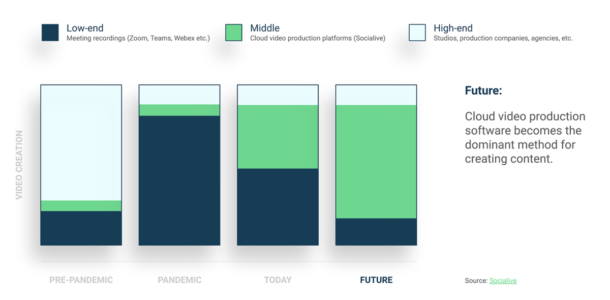
The growing middle tier of video creation
Cloud video creation is tech that allows anyone to record, edit, publish, or livestream video from a single, unified platform. Because cloud video creation platforms like Socialive are powered by cloud technology, they’re easily accessible by all team members — whether they’re collaborating together onsite or from afar.
This accessibility — combined with Socialive’s HD recording, intuitive editing, one-click publishing, and streamlined integrations — has empowered more video content creators across the enterprise. These content creators occupy a growing middle tier of video creation that embodies both professional quality and ease of use.
High-end videos, like those outsourced to production studios, typically require a massive budget and long timeline. Low-end videos, on the other hand, can be quickly and cheaply recorded on virtual meeting platforms, but you’ll have to sacrifice quality. A cloud platform such as Socialive enables organizations to have the best of both worlds. Users can create videos that look like they were produced by professionals, even if no experts were involved — and all the complicated, costly hardware and software that comes with professional production.

Top 4 benefits of remote video creation for enterprises
In addition to the ability to more easily create professional-grade videos with dispersed teams, remote video creation provides several key benefits for enterprises:
1. Transform enterprise-wide communications
Video-first communication strategies are all the rage these days. But actually implementing them is easier said than done, especially when 95% of the video services professionals we surveyed said they’re at or over their work capacity. Socialive’s intuitive features empower departments across the organization to independently create their own videos. Reducing the strain on internal video services teams then frees them up to focus on highly technical projects where their expertise is needed most.
2. Amplify diverse voices
Historically, the people that organizations feature in video content has been limited by geography. Employees or customers who live in locations outside a central hub are often left out. Thanks to its cloud technology, Socialive can be accessed by anyone, anywhere, using the devices they already have on hand. As a result, organizations can feature more diverse voices across the globe. And our recordings library gives teams instant access to recorded videos in a secure, centralized location in the cloud, ensuring more visibility.
3. Boost engagement and reach
No matter what department you’re in, you need engagement from your audience, whether that’s your customers, prospects, social media communities, virtual event attendees, employees, or investors. Remote video creation enables departments across the organization to move away from static, fatiguing video calls and start making more compelling content. With simulcasting and one-click integrations, you can easily meet your audiences where they are. Distribute video across all your social, digital, conferencing, and event platforms with the click of a button.
4. Scale video content output and increase ROI
Remote video creation allows teams to dramatically decrease their tech stacks. Many organizations rely on separate tools and technologies — which often require complex, manual processes to work together — to create content. Socialive’s unified solution, however, has everything you need to record, edit, publish, and livestream professional video all from a single platform. Not only does an end-to-end platform cut down expenses, it streamlines processes, improving time to market and increasing overall content output.
How different departments use remote video production
Now that we’ve covered the benefits of remote video creation, you might be wondering how different departments put it into practice. The good news: Every department can — and should — remotely create videos to drive business value across the organization. Here’s how:
- Marketing: Fresh, on-brand video experiences help marketers connect with prospects and inspire customers to become evangelists. Use cases include product demos, case studies, how-to videos, virtual events, and so much more.
- Corporate communications: Authentic videos featuring real people help communications teams tell stories that connect more deeply with their internal and external audiences. Use cases include CEO fireside chats, employee spotlights, earnings calls and briefings, and corporate brand videos.
- Learning and enablement: More engaging training videos get your employees up to speed faster. Plus, remote recording enables employees to capture valuable learning content on the job, and quickly share it with the rest of the organization. L&E use cases include employee onboarding, upskilling, and customer training.
- PeopleOps: HR and recruiting teams leverage video to engage employees and attract top talent in a competitive marketplace. Use cases include showcasing a day in the life of an employee, amplifying diverse voices, and hosting virtual recruitment events.
- Video services: Internal creative teams can take advantage of remote video creation to maintain quality while simplifying workflows to ultimately create more content — faster. These teams then have the bandwidth to help other departments achieve their goals while also making time for more advanced projects, like animation.

Socialive’s all-in-one video creation platform
Powered by cloud technology, Socialive’s platform enables not only remote video creation but also the recording, editing, and publishing of video content. By unifying these processes in one platform, Socialive simplifies workflows, enabling teams to quickly scale professional video creation. Reduced costs and time savings unlock company-wide use cases, like those listed above, to support overall business goals.
How the Socialive platform works
- High-quality recordings: Crowdsourcing recorded content across the business multiplies video creation efforts while empowering more diverse voices throughout the organization.
- Remotely record 4K and HD video with the devices you use every day (a laptop, smartphone, or tablet) or a professional camera, if you have one on hand.
- Everyone in your organization can record up to 4K video from anywhere at any time via their browser or the Socialive mobile app.
- Recorded videos are automatically transferred to your secure, centralized recordings library in the cloud.
- Recording a group? Collaborate with up to 20 people and direct the action from the Virtual Green Room.
- Our platform automatically captures both composites and ISOs, facilitating more efficient post-production and content repurposing.
- Fast, easy editing: An intuitive experience that empowers anyone to clip, add branding, layouts, and overlays.
- Enable low-tech users to get professional-grade video content from a take with just a few clicks.
- Custom intros and outros with logo and name card overlays are easily applied. Plus, smart layouts are soon coming available for screen share.
- Final video assets with approved look and feel ready to publish in minutes.
- One-click file transfers and publishing: Automate file transfers and push content to an array of integrated platforms.
- Publish across social media channels and a number of integrated platforms and tools. Streamline file transfers in a secure, cloud-based environment.
- Studio-quality livestreaming: Simultaneously stream live broadcasts to multiple channels from the powerful virtual studio.
- Livestream across social media channels and virtual events platforms, publish content on demand, or broadcast directly to internal tools like Zoom and Microsoft Teams.
- Embed live or on-demand content directly on your website to capture more traffic, leads, and conversions.
- Encourage real-time audience engagement with Q&A, polls, reactions, and more.
Socialive is the fastest and most cost-effective way to create and publish professional video
But that’s not all. Our platform was built to meet the scale, flexibility, and security needs of the enterprise. We have best-in-class, always-accessible customer support and robust onboarding. And we pride ourselves on our partnership approach by helping organizations uplevel their enterprise-wide video strategy.
Company Earns Placement on Built In’s “Best Remote Companies to Work For” List for Its Highly-regarded Culture and Workplace Methods
LOS ANGELES — Jan. 5, 2022 — Socialive, the self-serve video content creation platform for the enterprise, today announced it was selected as a 2022 Best Place To Work by Built In. The annual awards program includes companies of all sizes, from startups to established enterprises, and honors both remote-first employers as well as companies in the eight largest tech markets across the U.S.
“This recognition as a best place to work reflects our commitment to creating an empathetic and people-first organization,” said David Moricca, founder and CEO of Socialive. “Going forward, the companies that succeed will be those that prioritize the importance of human connection in their employee engagement strategy, whether that be in person, virtual or in a hybrid manner. We continuously live out this value and create a thriving workplace culture that empowers our employees — wherever they may be working — to do their best work and be their best selves.”
Built In determines the winners of Best Places to Work based on an algorithm, using company data about compensation, benefits and companywide programming. To reflect the benefits candidates are searching for more frequently on Built In, the program also weighs criteria like remote- and flexible-work opportunities, programs for diversity, equity and inclusion (DEI) and other people-first cultural offerings.“It is my honor to extend congratulations to the 2022 Best Places to Work winners,” said Sheridan Orr, chief marketing officer at Built In. “This year saw a record number of entrants — and the past two years fundamentally changed what tech professionals want from work. These honorees have risen to the challenge, evolving to deliver employee experiences that provide the meaning and purpose today’s tech professionals seek.”
About Built In
Built In is creating the largest platform for technology professionals globally. Monthly, more than three million of the industry’s most in-demand professionals visit the site from across the world. They rely on our platform to stay ahead of tech trends and news, develop their careers, and find opportunities at companies whose values they share. Built In also serves 1,800 innovative companies of all sizes, ranging from startups to the Fortune 100. By putting their stories in front of our uniquely engaged audience, we help them hire otherwise hard-to-reach tech professionals, locally, nationally, or remotely. www.builtin.com
About Built In’s Best Places to Work
Built In’s esteemed Best Places to Work Awards, now in its fourth year, honor companies across numerous categories: 100 Best Places to Work, 50 Best Small Places to Work, 100 Best Midsize Places to Work, 50 Companies with the Best Benefits and 50 Best Paying Companies, 100 Best Large Companies to Work For, and 50 Best Remote-First Places to Work.
About Socialive
Socialive powers self-serve video content creation for the enterprise. It’s the fastest, easiest way to create, broadcast, and distribute unlimited live and on-demand videos with studio quality. The Socialive platform puts intuitive, professional-grade video production workflows into the hands of content producers and everyday business users, lowering the barrier to entry and increasing employee-created video output. Videos enable brands to connect with people in fresh, dynamic ways, but it’s hard to produce great videos at scale while maintaining brand standards — budget, team capacity, and internal expertise can be in short supply. Just-in-time production with Socialive unlocks use cases for video that build human connections through relatable content, turning video into a powerful engagement channel for employee, customer, and partner communities to strengthen brand loyalty and company culture. Socialive’s Studio in the Cloud™ and integrated Virtual Green Room preserve the authenticity of live video while streamlining the end-to-end process from creation to delivery, consolidating the number of tools traditionally required for video production. Mobile-friendly and simple to use, Socialive helps bring together diverse people and perspectives to amplify voices distributed across organizations and geographies. The platform’s industry-first remote recording capability captures high-quality video from any device anywhere with full enterprise-grade control. Leading enterprises and high-growth companies, including Charles Schwab, Deloitte, Nike, Oracle, TikTok, The New York Times, Walmart, and Zendesk, use Socialive to drive business value through better, more frequent video creation. Meet the Moment With Video.™
Media Contact
Jennifer Burak
VP of Marketing, Socialive
'2021 State of Enterprise Video: Creation, Broadcasting, Distribution’ Report from Socialive Reveals Time, Budget, and Bandwidth Constraints Are Top Limiting Factors to Video Content Creation
LOS ANGELES – Oct. 7, 2021 – Socialive, the self-serve video content creation platform for the enterprise, today announced results from the 2021 State of Enterprise Video: Creation, Broadcasting, Distribution study, revealing that 84% of enterprises experienced increased demand for video content in the past year. The majority (87%) of respondents also say their organizations plan to make changes to decrease the impact of virtual meeting fatigue in the next 12 months, with 50% of enterprises planning to decrease meeting fatigue by producing higher-quality and more engaging video content to replace certain meetings. With the majority struggling to keep up with the demand for video content, respondents expressed strong interest (83%) in self-serve video technology to support the creation of new videos. Conducted in September 2021, the survey of more than 600 enterprise professionals across marketing, HR and video services departments shows that use cases for video are rapidly multiplying, enabling businesses to reach wider audiences, improve customer engagement, support learning and development, recruit and retain employees, and sell more products and services.
“If the past year has proven anything for businesses, it’s that they must be intentionally dynamic to adapt and stay competitive in today’s volatile market. The move to remote and hybrid work has inspired many companies to find new ways to engage their core audiences of customers, prospects, partners, and employees — or risk falling behind,” said David Moricca, founder and CEO of Socialive. “As our latest research underscores, video is quickly becoming the new standard for enterprise storytelling and communication, which has led to a surge in video creation across departments.”
Pandemic Prompts Enterprises to Embrace Video Across Departments
The vast majority (84%) of surveyed businesses report their company’s video content output increased in the last year, with one in four respondents citing a significant increase. Enterprises show no signs of slowing down the pace of video content creation in the year ahead; 88% of respondents anticipate their company’s video output to increase in the next 12 months. To accommodate growing demand, most respondents (82%) expect to see some increase in their organization’s budget for video content creation, broadcasting and distribution in 2022.
When asked which team within their company is the main creator of video content, respondents cited the following as the top three: internal video services or production teams (34%), followed by marketing teams (29%) and creative teams (19%). Some departments are also more likely to use video than others. Fifty-nine percent of respondents report that marketing teams are using video most often, followed by sales (39%), customer success (36%), and HR (32%).
When asked what benefits their company has seen from using video content, 58% of respondents said video helped them reach wider audiences. Additional reported benefits of video include:
- Improving remote workforce engagement (52%)
- Improving their ability to train staff quickly (48%)
- Enabling their company to sell products or services more effectively (41%)
As the Demand for Video Content Increases, Challenges Emerge
More than half (55%) of respondents cited that it has been challenging for their organizations to create, broadcast, and distribute video content with a remote or hybrid workforce. Thirty-seven percent of respondents cited time constraints as the biggest limiting factor to creating, broadcasting, and distributing video content, followed by budget constraints (36%) and bandwidth limitations (25%). Additionally, nearly three in five respondents reported that they are often overwhelmed by having to use so many different technologies to create, broadcast, and distribute video content.
Alternatives Sought to Video Conferencing Tools That Cause Meeting Fatigue and Shorten Attention Spans
Ninety-three percent of surveyed businesses have used standard video conferencing tools for virtual events in the past 12 months. However, nearly half of respondents (42%) only experienced moderate engagement throughout the event. Twenty-nine percent of respondents also reported that these events received higher engagement at first, with attention dropping off over the course of the video event.
A potential cause of diminishing engagement for virtual events is the rise of “virtual meeting fatigue,” which is characterized by tiredness, worry, or burnout associated with the use of virtual platforms of communication, particularly video conferencing tools. One study suggests that nearly half of remote workers have experienced a high degree of exhaustion as a direct result of numerous daily video calls.
The majority (87%) of respondents said their organizations plan to make changes to decrease the impact of virtual meeting fatigue in the next 12 months.
- To address this fatigue, half of respondents say their organization plans to produce higher quality and more engaging video content to replace certain meetings.
- This is followed by reducing the length of virtual meetings (45%) and reducing the overall volume of virtual meetings (36%).
Democratizing Video Content Creation With Self-Serve Technology
The research found that there is a strong enterprise interest in self-serve video content creation technology. In fact, the majority (83%) of respondents believe their company would create more video content if technology made it possible for anyone to more easily create video content without requiring prior video expertise.
Moricca continued, “Traditional video content creation, broadcasting, and distribution have required a large number of disparate, expensive tools, specialized skills, and extensive planning. As the demand for new video content increases, many enterprises are seeking out new ways to ease the burden and enable more individuals to become their own video producers. At Socialive, we believe that any business professional can become their own video creator, regardless of their technical expertise.”
Key Findings from Marketing Professional Respondents
- The vast majority (94%) of enterprise marketers see video as an effective tool to engage external audiences such as customers, prospects, and partners.
- Common use cases for marketing video content include communicating with existing customers (65%), engaging with audiences on social media (55%), and supporting events (49%).
- Marketers face high volumes of video content requests, with many teams creating new video content monthly (85%), weekly (40%), or daily (17%).
- Marketers are prioritizing ways to improve their time to market for video content (53%), increase their overall output of video content (44%), and increase engagement (42%).
Key Findings from HR Professional Respondents
- Almost all HR teams (93%) see video content as an effective tool to engage employees.
- The top enterprise use case for HR video content is employee learning and development, as cited by 72% of respondents.
- Eighty-five percent of HR teams expressed interest in using more video content to showcase and empower diverse voices throughout their organizations.
- Similar to marketers, HR professionals are also creating high volumes of new video content, with teams creating new video content monthly (82%), weekly (42%), or daily (10%).
- When asked their top video priorities for the next year, half of HR professionals cited improving the quality of an event experience, followed by increasing interactions or engagement across channels with video (45%) and creating better experiences for their audience (42%).
Key Findings from Video Services Professional Respondents
- Nearly four in five video services professionals stated that the amount of videos their team is required to produce has increased in the past 12 months.
- Ninety-five percent of video services professionals report they are at or over their work capacity, with 17% of respondents stating they are significantly over capacity.
- The top limiting factors for video services professionals to create new content include the time required to deliver high-quality video content (35%), having to use multiple, disparate solutions (33%), being asked to create more video content than ever (31%) and the challenges posed by producing high-quality video with remote talent (29%).
- In the year ahead, video services teams plan to prioritize increasing overall video content output and simplifying their tech stack for video projects.
In tandem with the 2021 State of Enterprise Video: Creation, Broadcasting, Distribution report, Socialive unveiled its vision for Enterprise Video Transformation, a third wave of digital transformation characterized by the ubiquitous use of video for storytelling and audience communication in the enterprise. The company also announced the next-generation Socialive platform featuring its industry-first Dual Recording Technology™, which unifies live broadcasting and studio-quality remote recordings to democratize video content creation.
To learn more, view the full report.
Additional Resources
Learn more about Socialive on our website
Follow us on Twitter @GoSocialive, LinkedIn, Facebook and Instagram
About Socialive
Socialive powers self-serve video content creation for the enterprise. It’s the fastest, easiest way to create, broadcast, and distribute unlimited live and on-demand videos with studio quality. The Socialive platform puts intuitive, professional-grade video production workflows into the hands of content producers and everyday business users, lowering the barrier to entry and increasing employee-created video output. Videos enable brands to connect with people in fresh, dynamic ways, but it’s hard to produce great videos at scale while maintaining brand standards — budget, team capacity, and internal expertise can be in short supply. Just-in-time production with Socialive unlocks use cases for video that build human connections through relatable content, turning video into a powerful engagement channel for employee, customer, and partner communities to strengthen brand loyalty and company culture. Socialive’s Studio in the Cloud™ and integrated Virtual Green Room preserve the authenticity of live video while streamlining the end-to-end process from creation to delivery, consolidating the number of tools traditionally required for video production. Mobile-friendly and simple to use, Socialive helps bring together diverse people and perspectives to amplify voices distributed across organizations and geographies. The platform’s industry-first remote recording capability captures high-quality video from any device with full enterprise-grade control. Leading enterprises and high-growth companies, including Charles Schwab, Deloitte, Nike, Oracle, TikTok, The New York Times, Walmart, and Zendesk, use Socialive to drive business value through better, more frequent video creation. Meet the Moment With Video.™
Media Contact
Jennifer Burak
VP of Marketing, Socialive
As hybrid work becomes the norm for knowledge workers, some employees are at risk of being ignored.
According to a new survey from Future Forum, 58% of knowledge workers from the U.S., Europe, Australia, and Japan now work in hybrid environments. That’s the first time since the start of the pandemic that the majority of workers have reported hybrid work arrangements, indicating the trend is here to stay.
While the survey found that caregivers and employees of color overwhelmingly prefer flexible, remote arrangements, these workers are at greater risk of being overlooked compared to their in-person colleagues. Executives, who are more likely to return to the office according to the survey data, tend to unconsciously favor other in-person workers — a phenomenon known as proximity bias. As a result, not only are remote workers’ voices often lost in the shuffle, they’re also less likely to be recognized and rewarded for their work via promotions, raises, and other merit increases.
But HR and internal communications leaders can help these workers’ voices be heard. Remote recording video technology enables employees to securely record and share video content to a centralized, cloud-based library from anywhere, using the devices they already have on hand. These videos can then be shared across the organization, ensuring underrepresented workers remain visible.
Crowdsourcing employee video content
By sharing user-generated video content from your employee base, your organization can amplify the voices of various groups. The intuitive Socialive platform enables any employee — regardless of video experience — to remotely record up to 4K video from a computer, smartphone, tablet, or professional camera. Our start/stop feature allows users to start and stop recordings directly from their devices, ultimately saving storage space and improving upload times.
Additionally, asynchronous videos can keep dispersed teams close while still providing the level of flexibility desired by working parents and employees of color. To ensure enterprise security, videos are never stored on the device itself. Rather, each remote recording is automatically transferred to your organization’s recordings library, where it can be centrally accessed by your team.
Consider leveraging a mix of live and on-demand video to keep employees connected and engaged both in real time and on their own time. You can even intersperse recorded videos with live broadcasts. For example, during a hybrid town hall meeting, you could build scenes with pre-recorded messages from remote employees to play in between announcements from in-person leaders, which are in turn broadcasted to remote employees.
5 remote recording ideas to get you started
As we found in our 2021 State of Enterprise Video report, video use cases among HR and internal comms are only growing. Some of our favorites to empower more voices throughout the enterprise include:
- Develop comprehensive onboarding experiences. Even if you have talent who can come into the office for their onboarding, you should strive to create consistent experiences for all employees. That means developing virtual onboarding programming intended to train all new hires — regardless of location. Be sure to feature videos of remote-only employees as well as those who are unable or do not wish to come into the office on a regular basis so all new talent hears from these voices.
- Share employee stories. One of the best ways to elevate employee voices throughout your company is to simply share their stories. Encourage employees to record videos talking about their roles, career journeys, and hobbies outside of work. These videos can then be shared and consumed asynchronously by the broader organization. You can also incorporate employee stories into your onboarding process by asking all new hires to record a short video. Additionally, you could host live virtual events featuring the voices of workers who often don’t get facetime with senior leadership, like interns. Salesforce, for example, uses Socialive to explore the future of work in a LinkedIn Live series led by their interns.
- Foster an inclusive community. By leveraging video content to disseminate thought leadership around inclusivity, you can create a stronger sense of belonging and community in your organization. For instance, Boston Consulting Group used Socialive to host a LinkedIn Live conversation about allyship between their CEO and their North American Leader of Women@BCG.
- Provide peer resources. Focus on broadening your L&D and training programs to include more faces from your employee base. In addition to sharing a static employee handbook, include video components where employees talk about why certain company values are important to them. And now that it’s more challenging to educate colleagues in person, record training sessions that can be easily shared among peers.
- Host truly hybrid town halls. Too often, hybrid town halls end up providing a better experience to in-person attendees, whereas virtual attendees are essentially an afterthought. As outlined above, you can use Socialive to build scenes that include live or recorded videos from employees who aren’t physically present in the office. You can even integrate an audience engagement tool with your broadcast that allows virtual attendees to participate in live Q&As, polls, and more.
Hybrid work is here to stay. And it’s up to PeopleOps leaders to create an environment where employees feel heard and valued — whether they’re in the office or working remotely. Easy-to-use remote recording platforms like Socialive can help empower diverse voices across your organization, mitigating proximity bias and improving parity among your workforce.
We are thrilled to announce a new strategic agreement with GlobalMeet, a market-leading virtual events and webcasting company.
This agreement combines advanced, high-quality video production technology with a comprehensive business communications platform, allowing customers to produce, broadcast, and distribute content at all stages of an event — no matter where they are.
An end-to-end Solution for Enhanced Video Creation and Event Strategy
The announcement is especially exciting because Socialive and GlobalMeet are both championing the same cause: empowering businesses to seamlessly connect and communicate. Below, we dive into the key benefits of this collaboration.
Deliver quality content at scale
Socialive empowers all business users to easily create high-caliber, engaging content for live streams and on-demand video at scale. Across every business function, anyone can take the event experience to the next level with:
- Brandability
- Multi-presenter layouts
- On-screen graphics with powerful calls to action
- Ability to simulcast to multiple channels so you can reach wider audiences
Best of all, it’s easy and effortless - no video expertise required. Teams using the solution can produce, broadcast and deliver high-quality content within Socialive, with full access to GlobalMeet Webcast's platform to host global audiences and measure impact.
Improve workplace engagement
Building relationships and boosting engagement through video is critical to every touchpoint of the employee and customer lifecycle, especially in a hybrid world.
The Socialive + PGi agreement facilitates event success and extends your ROI at every stage.
Make the most of the virtual event experience
When you spend one month planning an event that turns into a one-hour experience, don’t let that work go to waste.
Instead, make the most of your virtual event content and provide your audience with long-term value using Socialive and GlobalMeet Webcast. The solution unlocks the ability to leverage Socialive’s recording and clipping capabilities to generate more pre-event video teasers and post-event snackable videos to be shared across social media, partner, and demand generation channels.
It’s easier than ever to build excitement and drive attendance for next year’s event through promotional mash-up videos, or slice up a sizzle reel with HD ISOs for sponsors.
Your virtual event is content.
Amplify your messages before, during, and after your event.
Hint: You can do it yourself. You don’t need to blow your budget on expensive equipment or studio space to create professional-quality video.
You probably already have a general idea of what corporate video production is, or else you wouldn’t be here. Just in case, we define corporate video production as the creation of video by businesses for business use cases. That video can be just about anything, from product demos to case studies.
What the other guides to corporate video production don’t tell you is that the landscape has changed. Technological advances coupled with shifts to the way we work and collaborate have resulted in quicker and more cost-effective solutions.
Now, organizations can create studio-quality video — without the studio.

DIY corporate video production, without the DIY appearance
Traditional video production typically requires a big budget and long timeline to accommodate shooting on location, using expensive equipment, and hiring a full video crew to handle recording, post-production, and distribution.
At the onset of the pandemic, however, organizations were forced to change the way they work. For a while, it wasn’t safe to gather together in person to produce videos. Many businesses turned to makeshift solutions to keep the lights on, like remotely recording talent on Zoom.
While in-person activities have now resumed, the way we work has fundamentally changed. Dispersed teams were already common, especially for large, global companies. COVID-19 simply accelerated this trend and provided a proof of concept for all types of businesses, industries, and job types.
It’s certainly possible to return to traditional video production. But it’s also much more challenging to gather your team and talent together in the same location when the world of business is no longer bound by geography.
At the same time, the makeshift solutions companies turned to during the pandemic won’t cut it long term due to quality issues and complex workflows.
So where does that leave us?
Cloud video production has emerged as the cornerstone for creating high-quality video at the pace and scale of modern business. That means organizations can produce video in house, without the DIY appearance of a laggy conference call.
The importance of a unified workflow
When organizations contemplate moving video production in house, they often raise several valid issues. But a cloud-based, all-in-one platform can solve for those. Here’s how:
Cost
One of the main reasons why corporate video production can cost so much money is because many organizations try to replicate the production house experience. They build onsite studios, hire a full video services team, and purchase all the expensive hardware and software needed to produce video the traditional way.
With Socialive, you don’t need the fancy equipment or a physical studio. Your team can remotely record, produce, distribute, and repurpose video straight from their browser.
Time
Disjointed tech stacks eat up valuable time.
Many corporations rely on one tool to record a broadcast, a different tool to add production elements, and yet another tool to distribute video to their audiences. If they want to cut their finished video into snackable clips, they have to track down the original recording, upload it to a video editing tool, and make the edits.
Socialive unifies the recording, production, distribution, and repurposing of video into a single platform, which saves teams countless hours. Plus, our one-click integrations with popular enterprise applications like Sprinklr, Google Drive, Frame.io, and Brightcove enable teams to work even smarter and faster.
Resources
A whopping 95% of the video services professionals we surveyed in our State of Enterprise Video report said they are at or over their work capacity. But finding support in today’s candidate-driven job market is challenging.
Thankfully, Socialive’s intuitive, drag-and-drop features make it easy for anyone — with or without technical know-how — to get up to speed quickly. By upskilling existing team members across departments, you can ease the burden on video services, or rely less on outsourcing video creation.
Scale
Businesses often struggle to scale video creation due to access issues.
Video files are typically stored on an individual’s computer, which can make tracking them down to view, edit, or repurpose difficult. Likewise, complex video software tools prohibit many employees from participating in the video creation process.
Socialive’s cloud-based platform gives employees centralized access to all video files in a secure location. All recordings are automatically transferred to your library, so you don’t have to hound individuals to get access to content.
And because our cloud platform can be accessed anywhere via desktop or mobile, more employees can contribute video content to their company’s library, exponentially expanding your video output.
TL;DR - A unified workflow is critical to successfully bringing corporate video production in house.

How to drive value across the entire organization
Video usage has skyrocketed across departments in recent years, driven by increased customer and employee demand, as well as the prevalence of dispersed work.
Marketers are creating brand videos and corporate events. HR professionals are creating employee onboarding and training videos. Executive communications teams are hosting fireside chats and CEO earnings calls. If a department exists, so does the opportunity to leverage video.
But viewers’ concentration has become fractured. Between social media and workplace apps, there’s always somewhere else for their attention to wander. Organizations need to create more engaging video content if they want to capture and maintain their audience’s attention.
Socialive makes it easy to add production elements such as audio and video overlays, recorded videos, graphics, and lower thirds in just a few clicks. By creating more dynamic video experiences, departments can drive real value across the organization:
- Attract top talent
- Accelerate employee productivity
- Increase employee engagement
- Increase employee retention
- Drive brand awareness
- Increase qualified leads and pipeline
- Increase customer expansion and retention
- Boost engagement and reach
- Amplify diverse voices
Instead of using video out of necessity or simply for the sake of creating content, strategic organizations are aligning their business goals with their video plans. This approach, however, requires a deep understanding of the business. By bringing corporate video production in-house, teams can ensure every video they create is impactful.
You can transform the way you create corporate video across the organization with a cloud video production solution. Cloud technology empowers organizations to produce more video in-house, scale their content output, lower costs, and reduce time to market.
Take a quick, self-guided tour of our platform to see how Socialive can help your organization bring corporate video production in-house.
Company Attributes 500% Revenue Growth to Skyrocketing Demand for Self-serve Video Content Creation in the Enterprise
LOS ANGELES – Nov. 17, 2021 – Socialive, the self-serve video content creation platform for the enterprise, today announced it placed 258th on the Deloitte Technology Fast 500, a ranking of the 500 fastest-growing technology, media, telecommunications, life sciences, fintech, and energy tech companies in North America. Socialive was recognized for the company’s 500% revenue growth from 2017 to 2020.
“Video has become the preferred means of storytelling, audience engagement, and communication for businesses over the past several years, experiencing record-breaking adoption during 2021 with no end in sight,” said David Moricca, founder and CEO of Socialive. “To meet the evolving needs of modern enterprises amidst this paradigm shift, we made significant investments in our self-serve platform for video content creation. As a result, there’s been a massive increase in demand for our solution across the Fortune 500 and high-growth companies. Our placement on the Deloitte Technology Fast 500 is a testament to the commitment and dedication of our entire team to help businesses drive value through better and more frequent video creation.”
According to The 2021 State of Enterprise Video: Creation, Broadcasting, Distribution study, 88% of enterprises today expect their video content output to expand dramatically in the next year to meet increased company-wide demand. However, producing great videos at scale while maintaining brand standards is challenging since companies often lack the budget, team capacity and internal expertise. With its self-serve video content creation platform, Socialive makes it fast and easy for enterprises to create, broadcast and distribute unlimited live and on-demand videos at studio quality. Socialive gives anyone the ability to become their own prolific video creator, regardless of their technical expertise.
“Each year the Technology Fast 500 shines a light on leading innovators in technology and this year is no exception,” said Paul Silverglate, vice chair, Deloitte LLP and U.S. technology sector leader. “In the face of innumerable challenges resulting from the pandemic, the best and brightest were able to pivot, reinvent and transform and grow. We celebrate the winning organizations and especially the talented employees driving their success.”
To learn more about Socialive, visit socialive.us.
About the 2021 Deloitte Technology Fast 500™
Now in its 27th year, the Deloitte Technology Fast 500 provides a ranking of the fastest-growing technology, media, telecommunications, life sciences, fintech, and energy tech companies — both public and private — in North America. Technology Fast 500 award winners are selected based on percentage fiscal year revenue growth from 2017 to 2020. In order to be eligible for Technology Fast 500 recognition, companies must own proprietary intellectual property or technology that is sold to customers in products that contribute to a majority of the company’s operating revenues. Companies must have base-year operating revenues of at least US$50,000, and current-year operating revenues of at least US$5 million. Additionally, companies must be in business for a minimum of four years and be headquartered within North America.
About Deloitte
Deloitte refers to one or more of Deloitte Touche Tohmatsu Limited, a UK private company limited by guarantee (“DTTL”), its network of member firms, and their related entities. DTTL and each of its member firms are legally separate and independent entities. DTTL (also referred to as “Deloitte Global”) does not provide services to clients. In the United States, Deloitte refers to one or more of the US member firms of DTTL, their related entities that operate using the “Deloitte” name in the United States and their respective affiliates. Certain services may not be available to attest clients under the rules and regulations of public accounting. Please see www.deloitte.com/about to learn more about our global network of member firms.
About Socialive
Socialive powers self-serve video content creation for the enterprise. It’s the fastest, easiest way to create, broadcast, and distribute unlimited live and on-demand videos with studio quality. The Socialive platform puts intuitive, professional-grade video production workflows into the hands of content producers and everyday business users, lowering the barrier to entry and increasing employee-created video output. Videos enable brands to connect with people in fresh, dynamic ways, but it’s hard to produce great videos at scale while maintaining brand standards — budget, team capacity, and internal expertise can be in short supply. Just-in-time production with Socialive unlocks use cases for video that build human connections through relatable content, turning video into a powerful engagement channel for employee, customer, and partner communities to strengthen brand loyalty and company culture. Socialive’s Studio in the Cloud™ and integrated Virtual Green Room preserve the authenticity of live video while streamlining the end-to-end process from creation to delivery, consolidating the number of tools traditionally required for video production. Mobile-friendly and simple to use, Socialive helps bring together diverse people and perspectives to amplify voices distributed across organizations and geographies. The platform’s industry-first remote recording capability captures high-quality video from any device with full enterprise-grade control. Leading enterprises and high-growth companies, including Charles Schwab, Deloitte, Nike, Oracle, TikTok, The New York Times, Walmart, and Zendesk, use Socialive to drive business value through better, more frequent video creation. Meet the Moment With Video.™
Media Contact
Jennifer Burak
VP of Marketing, Socialive
With so many of us working remotely now, it’s no surprise that today’s employees are disengaged and disconnected. While remote work has provided many with the flexibility to work more efficiently and achieve better work-life balance, the loss of in-person camaraderie has threatened workplace culture. That’s why many HR and internal community teams are turning to video to amplify employee voices, tell authentic stories, create a sense of community, and build a strong employer brand.
In our Creator Economy webinar series, host Katie Martell spoke with panelists Erin Fletcher, director of HR strategy & associate experience at Walmart, and Trish Fontanilla, head of community at Simplr. Their discussion centered around leveraging video to tell authentic stories across the enterprise — and build stronger workplace communities.
How Walmart empowers employee storytellers
According to Fletcher, feeling like we belong transcends business — it’s a basic human need. And video is a powerful tool in dispersed workplaces to facilitate that sense of belonging.
Walmart Workplace — the retailer’s digital town square that connects its associates and teams to Walmart’s strategy, business, and one another — was designed to empower the diverse voices of its one million+ employees. With so many employees working across every state in the U.S., video is crucial to building company culture.
In fact, Walmart equips its employees with video creation devices to encourage them to share their own stories with one another. They rely on video for everything from peer-to-peer training to recognizing associates for living up to specific Walmart values.
Walmart also builds employee community through The Difference Podcast, a weekly series highlighting Walmart leaders making a difference in their teams, stores, and communities. The podcast is recorded on video and available for on-demand consumption on YouTube.
Learn more about Socialive’s new one-click audio capture automation capabilities here.
How Simplr drives deeper connections
One of Fontanilla’s favorite quotes is from American writer Allan Gurganus: “Stories only happen to people who can tell them.” To that end, one of her core tenets as a community builder is to amplify diverse employee voices. And she relies on video to do just that.
One way Simplr builds community is by showcasing the impact that working at the tech company has on the lives of its employees. The internal video series features employees talking about how working at Simplr has enabled them to buy homes and start families, which Fontanilla says was very uplifting to watch around the holidays. By giving employees the video tools they need to share their authentic stories, Simplr is able to drive deeper connections and build a stronger culture.
Fontanilla also uses video to create personalized asynchronous videos — pre-recorded messages tailored to the unique recipient that can be viewed on their own time. After interviewing strong job candidates, for example, Fontanilla will follow up with a personalized thank-you video, which can move the needle in today’s candidate-driven market. Fontanilla also regularly sends employee appreciation videos to team members, making them feel valued for their contributions.
In 2022, businesses plan to rapidly accelerate their technological investments, according to new data from Gartner. "Our research this year showed that technology investments are going way up," said Monika Sinha, research vice president at Gartner, in a call ahead of the virtual Gartner IT Symposium/Xpo 2021. "In fact, technology investments are going to be at the highest they've been over the last decade."
Over the past several years, tech has been foundational to organizations’ digital transformation strategies — especially with the rise of remote and hybrid work. And video will continue to play a crucial role in the enterprise technology stack. In our recent State of Enterprise Video report, we found that 88% enterprises expect their video content output to increase in 2022.
Video enables businesses to reach wider audiences, improve customer engagement, support learning and development, recruit and retain employees, and sell more products and services. But organizations should take care to invest strategically in video solutions this year, or risk contending with a bloated or disjointed tech stack.
The need for consolidation
Too many enterprises focus on the short term when selecting new technologies. Often, they’re looking to solve a specific problem that already exists, which can lead to “band-aid” investments that provide a quick fix but disintegrate over time. What’s more, many organizations continue to add new technologies to their stacks in an attempt to augment a solution that isn’t working.
When it comes to video technology, many businesses rely on a patchwork of different digital tools and hardware for the creation, recording, broadcasting, and distribution of content. Bloated tech stacks like these often lack interoperability, making them costly, complex, and difficult to manage. Too many disparate technologies ultimately slow your team down and leave your organization vulnerable to future disruption.
To future-proof your video tech stack, you must consolidate it. A more unified approach enables organizations to better scale video output, create process efficiencies, improve customer experiences, and remain agile. As a result, you can innovate at scale, testing new ideas and bringing standout creative campaigns to market faster than the competition.
5 steps to simplify your video tech stack
One reason companies put off tech stack consolidation is they simply don’t know where to start. Technology is the lifeblood of modern business, and intentionally removing (some of) it from your stack can seem daunting. So we put together this checklist to help keep you on track:
- Map your video processes. Determine which technologies are used for each part of the video process across your organization. This should include the creation, recording, broadcasting, and distribution of video content, so be sure to get input from team members in every relevant department to ensure accuracy and alignment.
- Identify redundancies and excesses. Look for repetitive technologies or solutions that are no longer in use. Are you using two video technologies that perform the same purpose for different use cases? Are there video tools you pay for that aren’t being used in any of your processes?
- Prioritize cohesiveness. You might love using a specific video tool, but if it isn’t compatible with your company’s other systems and processes, you’ll hit roadblocks. Similarly, if you’re pushing audiences to third-party video players instead of your own website, you can create a disconnect between your customers and your brand.
- Evaluate vendors. Oftentimes, it’s strategic to abandon technologies that simply aren’t working. When evaluating new vendors, look for unified solutions like Socialive over individual tools to streamline processes and reduce complexities. Additionally, find a vendor committed to partnership to help you achieve your video goals while staying true to your company’s vision.
- Regularly reassess. To ensure optimal efficiency and performance, you should frequently re-evaluate your video tech stack. Set measurable KPIs that line up with your objectives, and communicate often with your vendor to identify room for improvement.
Enterprises are investing in new technology at historically high rates. But investment alone won’t get your organization very far without a forward-looking strategy. The sooner you future-proof your video tech stack, the sooner you can focus on the work that sets your business apart, ensuring greater resiliency down the road.
Ready to try an end-to-end video platform? Schedule a demo with us today.
Welcome to the era of enterprise video transformation
We've unveiled our vision for Enterprise Video Transformation — a third wave of digital transformation characterized by the ubiquitous use of video for storytelling and audience communication in the enterprise. Just as social media platforms such as YouTube, Instagram and TikTok sparked a massive shift in the way individual consumers create and engage with video content, the creator economy movement is transforming the enterprise: Video is fast becoming the preferred means of communication.
Until now, it’s been challenging to easily create professional-grade, on-brand video content within an enterprise at scale. Creating, broadcasting and distributing video was traditionally time-consuming and limited to those with deep expertise. Video production also required complex, expensive software and hardware, as well as hefty travel and production expenses. As a result, video was reserved for mission-critical campaigns. Since the pandemic, enterprises have also been facing a steeper uphill battle trying to engage their external and internal audiences in fresh, dynamic ways, especially with the rise of remote and hybrid workplaces.
Socialive’s groundbreaking technology changes the equation by making it possible for both everyday business users and video pros to easily and cost-effectively create an unlimited stream of high-quality video content relevant to enterprise audiences.
Democratizing video content creation will help meet massive new demand for video
According to the State of Enterprise Video: Creation, Broadcasting & Distribution study announced today, demand for video skyrocketed in the last year, with 84% of enterprises experiencing an increase in video content output over the last 12 months. This trend is by no means slowing down — an astonishing 88% of enterprise professionals anticipate their company’s video content output to increase in the next year. These findings signal loud and clear that the next wave of transformation in the enterprise is well underway.
Business communication has evolved significantly in the last few decades. From email and chat to video conferencing tools like Zoom, every company has access to technology for fast and personal communication. The future of enterprise communication will focus on telling better, more authentic stories and empowering more voices from across the organization. Businesses must equip their storytellers and make it easier to deliver high-caliber video content at scale.
The next-generation Socialive platform realizes our vision for Enterprise Video Transformation. By removing the complexities of video content creation, our platform empowers business users and video pros alike to produce high-quality videos anywhere, anytime and from any device. What’s more, line-of-business users can now tell better stories and deliver more genuine and thoughtful video experiences through Socialive’s self-serve technology, eliminating the need to rely on costly external agencies while freeing up internal production teams for more complex projects. Easy-to-use video creation workflows enable diverse people distributed across the organization to continually create fresh, authentic video content themselves. With significant advancements to existing platform features, including the Socialive Studio in the Cloud™, Virtual Green Room, Recordings Library and new mobile capabilities, the possibilities for video are limitless.
It’s incredibly rewarding to be fulfilling our mission to fundamentally transform the way video content is created, broadcast and distributed in the enterprise. Socialive is paving a way for global organizations to better connect and engage with their employees and customers, get more out of their video content and grow their businesses.
We believe that everyone has a story to tell. By lowering the barrier to entry for video creation, Socialive is giving enterprises the tools they need to humanize their businesses.